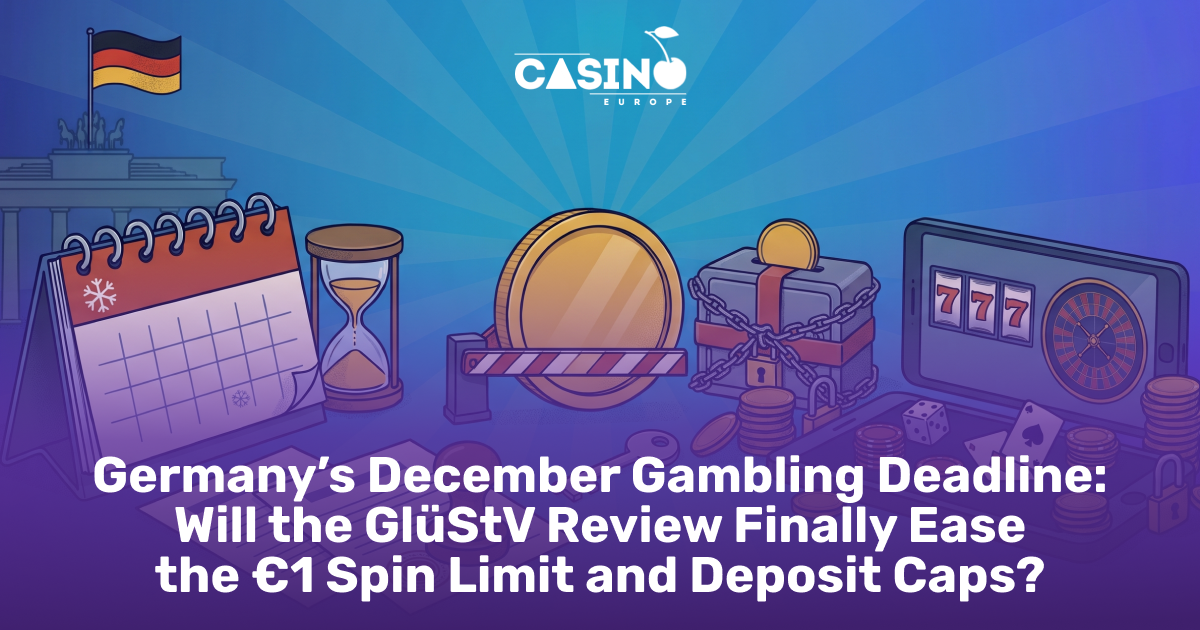
Germany’s December Gambling Deadline: Will the GlüStV Review Finally Ease the €1 Spin Limit and Deposit Caps?
Germany’s tightly regulated online gambling market is approaching its biggest inflection point in five years. Under Section 32 of the Interstate Treaty on Gambling (GlüStV 2021), regulators must deliver a formal evaluation report by December 31, 2026–a review that could decide the future of the country’s controversial €1 slot stake cap, €1,000 monthly deposit limit, and turnover tax.


When Germany launched its nationwide licensing regime in July 2021, lawmakers prioritized player protection above commercial competitiveness. Five years later, operators, trade associations, and even independent researchers argue that the rules have backfired–pushing millions of German players toward unlicensed offshore casinos where neither deposit caps nor self-exclusion checks apply.
What Is on the Table in the December 2026 Review?
The Joint Gambling Authority of the States (Gemeinsame Glücksspielbehörde der Länder, or GGL) oversees 129 licensed operators and brokers as of late 2026, yet legal platforms continue to struggle against black-market leakage. The upcoming evaluation is expected to center on four critical friction points:
| Regulatory Rule (GlüStV 2021) | Current Restriction | Why It Faces Pushback Ahead of 2027 |
|---|---|---|
| Virtual Slot Stake Cap | €1 per spin standard (temporary pilot allows up to €3–€5 under strict monitoring). | Low maximum stakes drive recreational and high-value players straight to offshore sites. |
| Monthly Deposit Limit | €1,000 per month across all licensed operators via the central LUGAS system. | Temporary GGL guidelines allowing higher limits (up to €10,000–€30,000 with affordability checks) expire on December 31, 2026. |
| 5.3% Turnover Tax | Taxed on every stake, not Gross Gaming Revenue (GGR). | Forces licensed casinos to cut slot RTPs down to 88–90%, making legal games mathematically uncompetitive. |
| Game & Speed Restrictions | 5-second minimum spin duration; no jackpots, autoplay, or federal live-dealer tables. | Creates a slower, stripped-down product compared to neighboring European markets. |
The July 2026 Trial: A Hint of Flexibility–With a Catch
Ahead of the year-end deadline, the GGL already signaled that the status quo is unsustainable. On July 1, 2026, the regulator introduced a time-limited guideline (valid through December 31, 2027) allowing licensed operators to raise virtual slot stakes above the €1 ceiling–up to €3 per spin for players aged 21 and over, and up to €5 after a 90-day period of verified, low-risk play.
While industry groups like the German Online Casino Association (DOCV) welcomed the move as a “positive signal,” operators note that raising stakes without reforming the 5.3% stake tax or extending enhanced deposit thresholds only solves half the problem. Furthermore, the current GGL framework permitting monthly deposit limits above €1,000 is explicitly set to expire on December 31, 2026, creating urgent pressure on lawmakers to establish permanent affordability rules before the 2027 licensing cycle begins.
Enforcement vs. Market Reality
German authorities have stepped up crackdowns on illegal operators–including a high-profile Frankfurt prosecution in September 2026 targeting an unlicensed network linked to €5.86 billion in wagers, alongside expanded ISP blocking powers introduced in July 2026.
However, industry consensus across Europe remains clear: blocking orders alone cannot fix poor channelization. Until the December 2026 evaluation leads to tangible reforms–particularly replacing the 5.3% turnover tax with a standard GGR tax and modernizing deposit caps–Germany’s licensed online casinos will continue fighting an uphill battle for their own players.