The 40% Tax Squeeze: How UK and European Online Casinos Are Quietly Cutting Slot RTPs
If your casino balance feels like it is disappearing faster than it used to, it isn’t just a bad run of luck. Following the UK’s steep hike in Remote Gaming Duty to 40% earlier this year, operators across Britain and wider Europe are quietly adjusting the math behind popular online slots.
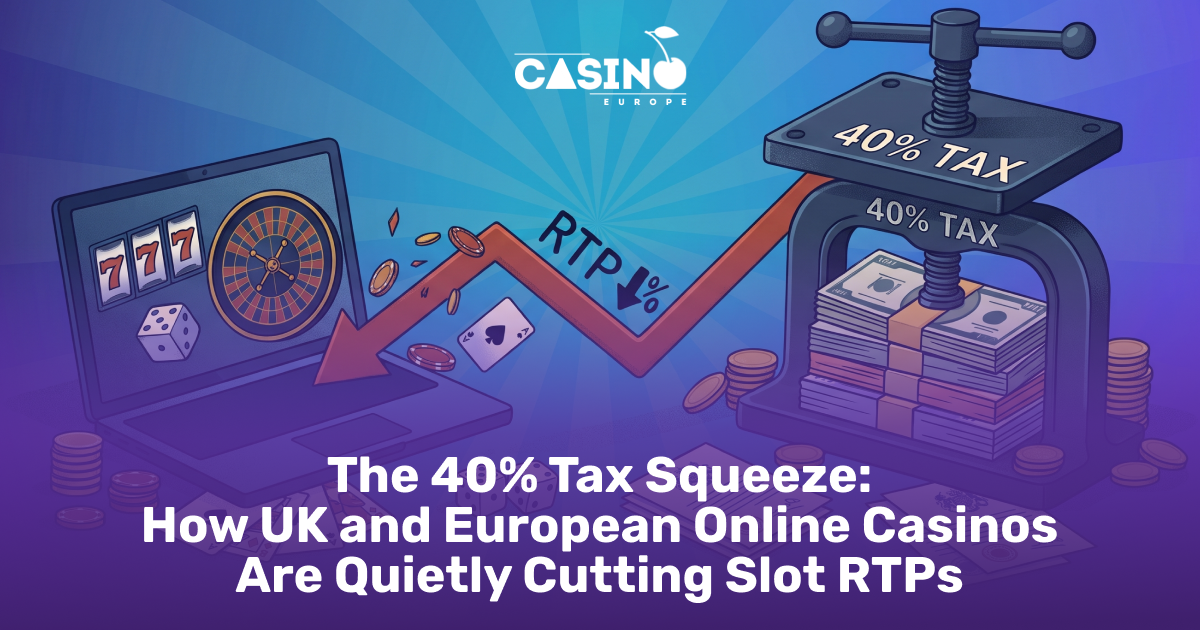


When the UK government raised Remote Gaming Duty (RGD) from 21% to 40% on April 1, 2026, Treasury officials openly acknowledged that operators would likely pass up to 90% of that cost onto consumers. Seven months into the new tax regime, players are feeling the impact directly inside their favorite games.
Instead of slapping visible fees onto deposits, many licensed casinos have turned to an invisible margin lever: lowering Return to Player (RTP) settings.
How RTP Adjustments Work Behind the Scenes
Most players assume that a flagship slot—such as Play’n GO’s Book of Dead or Pragmatic Play’s Big Bass Splash—plays identically no matter where you open it. In reality, game studios supply casinos with multiple certified RTP configurations of the exact same title.
Before the 2026 tax wave, a standard UK or European slot typically ran at roughly 96% RTP. Today, operators squeezed by higher gross gaming yield (GGY) taxes are increasingly opting for 91% or even 88–90% versions of the same games.
According to industry analysts at Regulus Partners, studios achieve these lower payout profiles by reducing the frequency of bonus rounds and mid-sized wins. On the surface, the graphics, reels, and bet sizes look identical—but the “entertainment value” of a deposit drops dramatically.
| Slot Metric | Standard Configuration (~96% RTP) | Tax-Adjusted Configuration (~90% RTP) | What It Means for the Player |
|---|---|---|---|
| Theoretical House Edge | 4.0% | 10.0% | The casino keeps 2.5x more per spin over time |
| Bankroll Recycling | High | Drops by ~50% | Balances deplete roughly twice as fast on average |
| Bonus Round Frequency | Standard | Reduced | Longer dry spells between free spins or features |
The “Germany Effect” Spreads Across Europe
The UK is not the first European market to test how far operators can push payout reductions before players walk away.
Germany introduced a strict 5.3% turnover tax on online slots alongside mandatory €1 spin limits, driving licensed operators to slash slot RTPs down toward the 88–90% range. The result became a cautionary tale for European regulators: average annual spend per player in Germany’s regulated slot market collapsed to roughly £5 per head (compared to around £55 in the UK), while the unlicensed offshore market ballooned to an estimated €2 billion.
Now, with the UK enforcing its 40% RGD rate—and markets like the Netherlands also debating tax hikes up to 37.8%—a clear divide is emerging among European casino brands:
- Margin-first operators are quietly swapping high-RTP builds for lower-paying variants while trimming welcome bonuses and free spins.
- Retention-focused brands (such as Hollywoodbets and Slots Temple in the UK) have publicly pushed back, committing to keeping standard 96%+ RTP configurations intact to win over disillusioned players.
How to Check Your Slot’s True RTP Before Spinning
Because UK Gambling Commission (UKGC) and European licensing rules require transparency, casinos cannot hide a game’s payout percentage—even if they don’t advertise the drop on the homepage.
Before placing real-money bets, take ten seconds to verify which version of a slot you are actually playing:
- Open the game’s info menu: Load the slot and click the “?”, “i”, or Paytable icon (usually located in the bottom corner);
- Scroll to the bottom of the rules: Look for the line stating “Theoretical Return to Player (RTP)”;
- Compare against the studio default: If a game like Book of Dead lists 91.25% instead of its standard 96.21%, you are playing a tax-adjusted version—and switching to a competing licensed casino could immediately give you significantly better odds on the exact same title.